Where the boxer rumble comes from
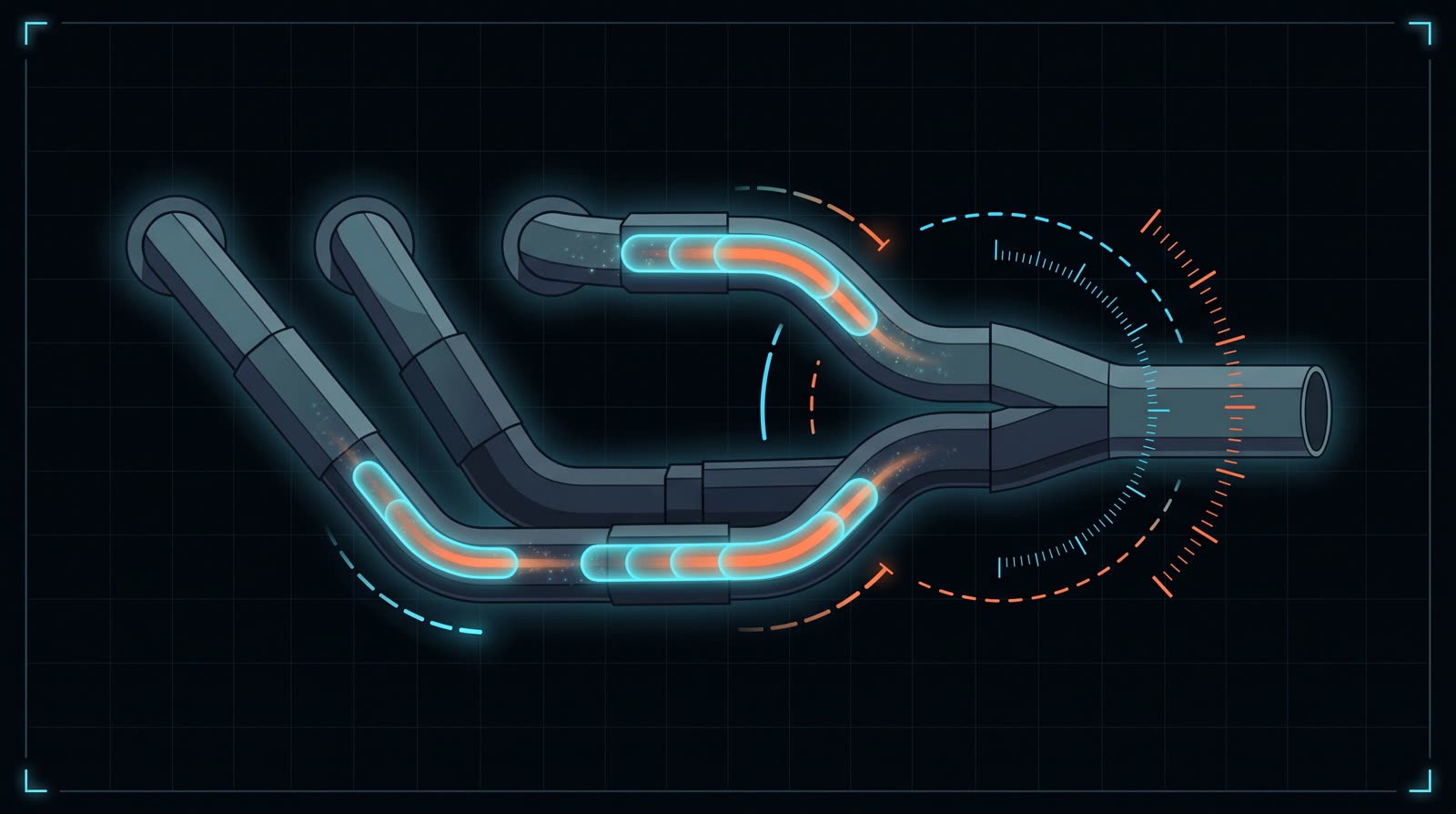
The flat-four boxer preset carries a firing unevenness of 34, produced by unequal exhaust header lengths meeting a collector at uneven intervals. Two cylinders sit closer to the collector than the other two, and that geometric asymmetry, rather than the horizontally opposed layout itself, is what produces the rumble a boxer is known for.
Two headers, two different lengths
A boxer four fires two cylinders on each side of the crankshaft, and the four exhaust runners feeding a single collector differ in length. Two cylinders sit closer to the collector than the other two, so pulses leaving the cylinders at evenly spaced crank angles arrive at the collector at uneven intervals. That mismatch in arrival time, rather than the cylinders lying flat and opposed, produces a boxer's rumble.
The flat-four boxer preset models that mismatch with a firing unevenness of 34, one of the higher figures in the range. The crossplane V8 built for lope, covered in an earlier post on crossplane and flat-plane V8s, carries unevenness of 38, and a straight six built for balance carries unevenness of 5. A boxer four, on paper the least exotic layout here, sits almost as high as a V8 built specifically for lope.
Firing unevenness does not change how many times an engine fires each revolution. That figure, called firings per revolution, comes from cylinder count, and a boxer four's two firings per revolution is identical to any other four-cylinder engine, including the naturally aspirated 2.0 reference engine. The boxer and the ordinary four share a fundamental note; what separates them is the unevenness sitting on top of it.
What unevenness adds to the note
Unevenness produces the half-order growl underneath an engine's main firing frequency, a low, textured layer that sits below the pitch set by rpm and cylinder count. At 34, the boxer's growl is closer in character to a V8 built for lope than to anything else sharing its pulse count, even though pulse count on its own says nothing about how much of that growl exists.
The air-cooled flat-six preset is also horizontally opposed, and its firing unevenness sits at 12, closer to the balanced end of the range than to another boxer. Adding a third pair of cylinders changes the header geometry enough that the arrival-time mismatch mostly cancels out, and the model reflects that with a figure a third of the flat-four's.
The flat-six's three firings per revolution, against the boxer four's two, set a higher-pitched fundamental note before either engine's unevenness is heard at all. Firings per revolution set the fundamental; unevenness decides what growls underneath it, and here the two flat engines make very different decisions about that second part.
The rest of the boxer's exhaust
Unevenness is not the only setting doing work here. The boxer preset carries a pipe length equivalent to a 13.5 millisecond first comb delay, against 10.5 milliseconds for the flat-six, so the exhaust resonance the comb filter adds sits at a lower frequency on the boxer. Comb feedback is set to 50, against the flat-six's 55, a small difference that leaves the boxer's resonance slightly less pronounced even before unevenness is added on top.
Bass emphasis on the boxer sits at 105 and fades out above 3,400 rpm, so the low end audible at idle and low revs gives way to mid-range growl as the engine climbs toward its 6,700 rpm redline. Overrun pop probability sits at 20 and cycle-to-cycle timing jitter at 10, both modest figures that add a little roughness around idle without pushing the engine toward the clatter of something like a diesel.
None of this depends on where the cylinders point. A flat-four idling at 800 rpm and shifting at 3,200 rpm across five gears from 7.8 to 37 km/h per 1000 rpm behaves, mechanically, exactly like an inline four with the same numbers. The rumble is a decision recorded in a handful of sliders rather than a property of the engine's shape.
What to listen for
On the boxer clip, listen for a thump underneath the main beat that thickens as revs climb, most audible in the mid-range before the 3,200 rpm shift point cuts it short. The same rise happens on the flat-six clip, but with far less of that undertone and much more of the induction hiss the noise setting of 135 puts into the mix, against the boxer's 105.
At idle, the boxer's higher unevenness and lower brightness, 90 against the flat-six's 115, put more of the sound energy low down and less of it in the upper orders, which is part of why a boxer at idle reads as a rumble and a flat-six at idle reads as a hum with an edge to it. Neither figure is about loudness; both engines are levelled the same way, and they spend their energy in different places.
The clips below make the difference audible in a way no further description can improve on.
A boxer's rumble has never come from the cylinders lying flat against each other. An inline four built with equally mismatched exhaust runners would produce the same effect, and the reason boxers were built that way while most inline fours were not is a matter of packaging history rather than physics. The model here does not know or care about cylinder layout either; it reads a number set to 34, and that number could as easily belong to an engine with no boxer in its name at all.
Hear it
Ten seconds each: an acceleration run through the gears, then the overrun. The same presets the numbers above come from.
- BOXER FLAT-4 2.42.0 · offbeat rumble
- AIR-COOLED FLAT-62.0 · classic 911 style