Why a diesel clatters
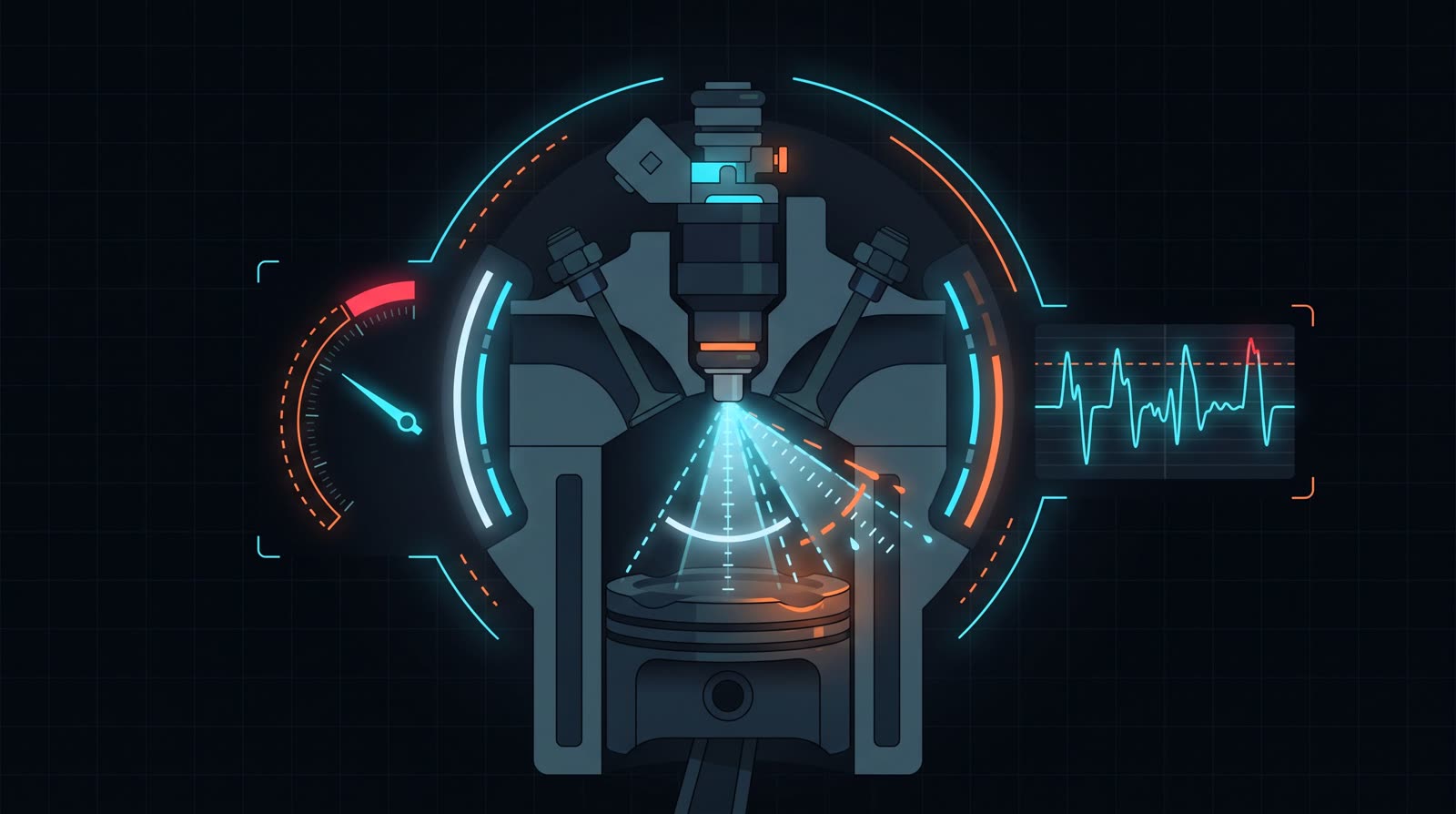
A diesel clatters because compression ignition lights each charge the moment the fuel-air mixture is ready to burn, not at a spark-timed instant, and that readiness shifts slightly from one cycle to the next. The diesel TDI preset models the effect as cycle-to-cycle timing jitter set to 18, more than double the petrol four's 7.
Ignition without a spark
In a petrol engine, a spark plug fires at a timed instant set by the ignition system, so combustion starts at a precise crank angle every cycle. A diesel has no spark plug: fuel is injected into air compressed until it is hot enough to ignite the mixture on its own. Combustion begins after an ignition delay, the interval between injection and the point where the fuel-air mixture catches, and that delay is sensitive to compression temperature, fuel atomisation and how completely the previous cycle's exhaust cleared the cylinder, none of which repeat identically from one stroke to the next.
Both the diesel TDI preset and the petrol four fire twice per revolution, the value the site calls firings per revolution, because both model a four-cylinder four-stroke and firings per revolution is cylinders divided by two. Same count, same fundamental note. What separates the two is how consistently each firing lands where it is expected, rather than how often each fires.
Jitter is a timing artefact, not an added layer
The parameter that carries this is cycle-to-cycle timing jitter, a small random shift in when each firing lands rather than a texture added afterwards. The diesel preset sets it to 18. The petrol four sets it to 7. Turn either engine's jitter to zero and firings would land on the beat with mechanical precision; turn it up and each one arrives a fraction early or late, which produces the loose, uneven knock at idle that a diesel is known for and a petrol four mostly avoids.
Intake and exhaust noise sits on a separate slider, set to 125 on the diesel against 100 on the petrol four. Noise is broadband hiss riding under the tone. Jitter changes the timing of the tone itself. A diesel's clatter is audible even at idle with the windows up, when there is little exhaust noise to speak of, because the ear is picking up irregular timing rather than extra hiss.
Unevenness adds the growl underneath
A second slider, firing unevenness, sits alongside jitter and does something different: it produces the half-order growl that sits underneath the main firing tone, the same parameter that separates a crossplane V8 from a flat-plane one at 38 against 24. The diesel preset carries unevenness of 22, the petrol four 10. Where jitter moves a firing's timing around from cycle to cycle, unevenness sets a repeating pattern of stronger and weaker pulses within the cycle, so the two work together rather than one substituting for the other.
A diesel needs both raised to sound like a diesel. Jitter alone would give the timing looseness without the underlying growl; unevenness alone would growl on a schedule too regular to sound like knock. Together, at 18 and 22 against the petrol four's 7 and 10, they are why the two engines can share the same firing count and idle speed and still be unmistakably different machines.
Slow to redline, quick to shift
The rest of the diesel preset supports the same character. Idle sits at 820 rpm against the petrol four's 850, close enough that idle speed alone would not tell the two apart, but the diesel's redline is 4600 rpm against 6800, and it shifts at 2300 rpm rather than waiting for 3100. The gear ratios are longer too, from 9 km/h per 1000 rpm in first up to 50 in top, against the petrol four's 7.5 to 37, which is the gearbox model's way of matching a torque-heavy engine that has no reason to be revved out.
The result is an engine that spends its working life in a narrow, low band, where the timing looseness that jitter produces is most audible, then hands off to the next gear before it has to prove anything at high rpm. Listen at idle, then listen through a gearchange, and the difference between the two engines is at its widest exactly where jitter is doing most of its work.
Two engines here share the same firing count and a similar idle speed, and still sound like different machines, because two sliders pull in different directions: timing jitter loosens when each firing lands, and unevenness shapes what growls beneath it. Neither substitutes for the other, and a diesel needs both turned up to sound like one.
Hear it
Ten seconds each: an acceleration run through the gears, then the overrun. The same presets the numbers above come from.
- DIESEL 2.0 TDI2.0 · clatter & torque
- CLASSIC 2.0 I42.0 · petrol sedan