The exhaust is a comb filter
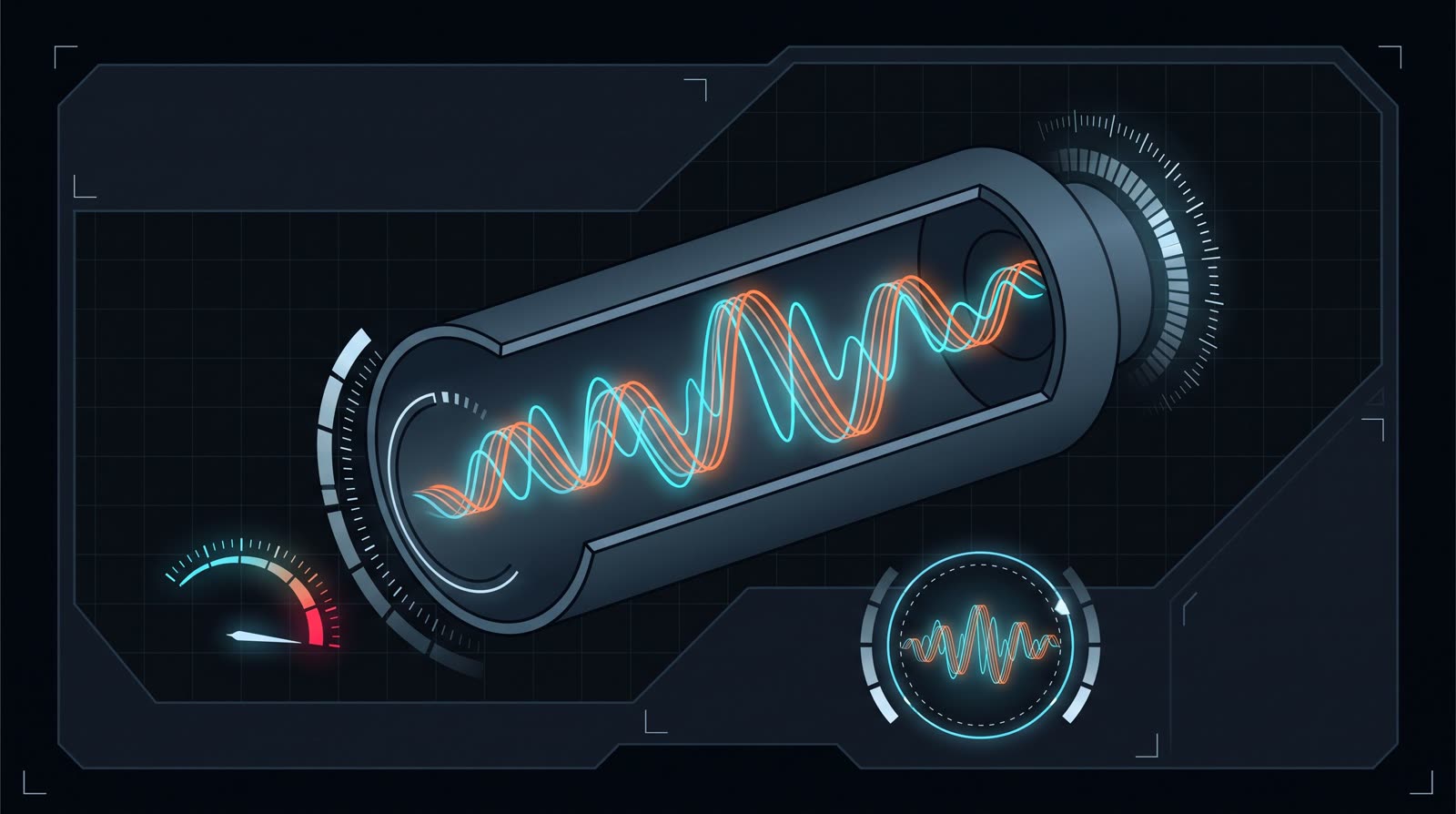
Every preset routes its exhaust through a feedback comb filter, and the pipe value sets how long that feedback loop takes to run. A short loop rings fast and high; a long one settles slow and low. The V10 preset uses a pipe of 75, the steam locomotive 220, and the gap between them is audible.
A delay line that feeds on itself
Every synthesised engine on this site runs its raw firing pulses through a short chain before they reach the speaker: a pulse train, an order bank, waveshaper saturation, filtered noise, and at the end a feedback comb standing in for the exhaust. A comb filter takes a signal, delays a copy of it, and adds that copy back onto the original. Do this once and the result is a single echo. Feed the delayed output back into its own input instead, and the spectrum grows a series of evenly spaced peaks and notches, which is where the name comes from: plotted against frequency, it looks like the teeth of a comb. The gearbox and synthesis pipeline runs this stage last, on the signal that is about to leave as exhaust.
Two numbers in each preset control it. Pipe length, given in decimillimetres, sets the delay: divide by ten and that is the time in milliseconds the loop takes to run once round. A short delay repeats quickly, which pushes the comb's peaks up towards the higher end of the spectrum and lets the ringing decay in a fraction of a second. A long delay repeats slowly, which pushes the peaks down and gives the ear time to notice each pass before the next one arrives. Comb feedback, a separate slider, sets how much of the delayed signal gets added back in on each pass, and so how loud that ringing is wherever it happens to sit.
Short and sharp: the V10 at 75
The V10 preset sets pipe length to 75, a delay of 7.5 milliseconds once divided by ten, the shortest of the three engines compared here. Comb feedback on this preset sits at 55. Firings per revolution are five and the redline is 8,500, an engine built to spend most of its working range well up the rev counter, and a short exhaust delay keeps the comb's resonance high enough to sit inside the same register as those firing pulses rather than answering from underneath them. The ring dies out quickly too, so near redline the exhaust reads as texture riding on the fundamental rather than a separate note beneath it.
Listen for how little separation there is between the firing pulses and whatever else is happening around them: the comb here adds shimmer rather than a distinct low note. The earlier piece on why a V10 screams covers what the firing order and unevenness are doing underneath; the pipe length is the reason the exhaust does not slow any of that down.
Long and slow: the muscle V8 at 150, the locomotive at 220
The muscle V8 preset doubles that pipe length to 150, a 15 millisecond delay, at the same comb feedback of 55 used on the V10. Nothing about the feedback amount changed between the two; only where the loop's resonance sits moved, from high and quick to lower and slower. Firing unevenness on this preset is set to 38, which is what produces the lope between firings that the crossplane and flat-plane V8 piece describes, and the longer comb delay gives that lope room to sit that a 7.5 millisecond loop would not allow.
The steam locomotive preset goes further again, to a pipe of 220, a 22 millisecond delay, the longest of the three. Comb feedback on this preset drops to 30 though, well below the 55 shared by the V10 and the muscle V8, so despite having the longest loop it rings less insistently than either. What fills the space instead is noise, set to 200 on this preset against 110 on the V10 and 95 on the muscle V8, plus the chuff itself, which marks each piston stroke directly rather than leaving the comb filter to imply it.
Two dials, moved independently
The point worth taking from all three is that pipe length and comb feedback move independently of each other. The V10 and the muscle V8 share a comb feedback of 55 and differ only in where the delay sits, which is why one sounds like shimmer and the other like a distinct note ringing under the firing pulses. The locomotive changes both at once, pushing the delay to its longest value here while pulling feedback down to its lowest, and that pairing is what keeps a 22 millisecond loop from turning into an obvious drone.
None of this claims to be an exact model of any real exhaust system. A pipe length in decimillimetres is a delay-line setting chosen to place a resonance where it is wanted, distinct from any measurement taken off a header pipe. What the three presets show is that the same feedback comb, given three different delays and two different feedback levels, can produce a scream, a lope and a chuff without anything else in the signal chain changing at all.
The comb filter is one stage among several, sitting after the waveshaper and the filtered noise in every synthesised preset on this site, and it is a small part of the chain to carry this much of what makes three very different machines recognisable as themselves.
Hear it
Ten seconds each: an acceleration run through the gears, then the overrun. The same presets the numbers above come from.
- ITALIAN V10 5.22.0 · high-rev scream
- MUSCLE V8 5.02.0 · crossplane burble
- STEAM LOCOMOTIVEpiston chuff · steam